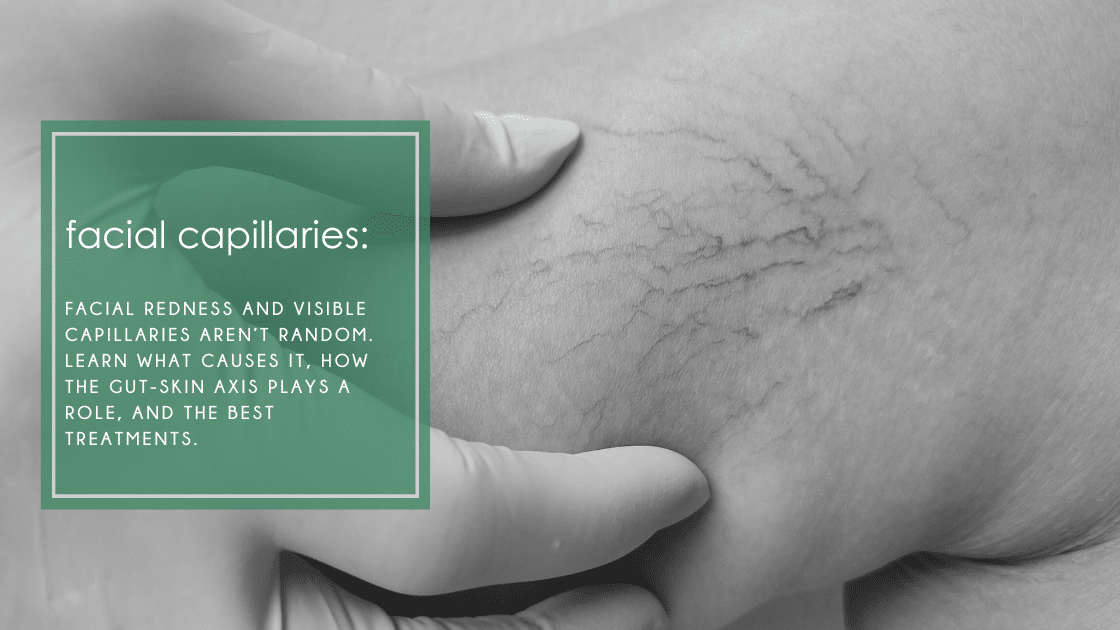
Facial Capillaries: Causes & Treatment Options
Why You Have Facial Capillaries
Facial capillaries, also known as spider veins or telangiectasia, are frustrating to treat. There are many underlying causes, and while they’re harmless, they can significantly impact your skin’s appearance and confidence. Today we are going to talk about what causes facial capillaries, foods to avoid, and topical and internal ways to heal your skin.
What are Facial Capillaries?
Our circulatory system is made up of veins and arteries transporting blood, oxygen, nutrients, and waste to and from the heart. Then we have arterioles and venules that connect veins and arteries to the capillaries; this is your off ramp. The capillaries’ job is to transfer nutrients and oxygen, and remove waste. Since capillaries are only one cell layer thick, which means they are easy to damage.
When capillaries become dilated or damaged, they can appear as visible blood vessels on the face, especially on the nose, cheeks, and chin. Though harmless, they can create persistent redness that worsens with age, exercise, nervous system activation, or temperature changes.
What Causes Facial Capillaries?
There are many factors that damage the capillaries, such as sun, age, temperature fluctuations, hormone changes (especially during pregnancy and menopause), and frequent allergies or colds (due to the pressure of blowing or wiping your nose). Facial capillaries are also prominent in those who suffer from rosacea as this can present as either broken capillaries or acne-like bumps that make the cheeks and nose area always appear red. As we age, our collagen begins to break down and this makes the skin thin, and capillaries appear more visible. The most common areas are the nose, cheeks, and chin.
Broken Facial Capillaries and Rosacea
Rosacea is a skin condition that appears in acne-like bumps or constant redness in the cheeks and nose. Flare ups triggered by heat or cold, spicy foods, UV exposure, intense exercise, and alcohol. Rosacea flare ups caused from sensory nervous system stimulation. The National Rosacea Society says, “In studying the neurovascular system in rosacea, Dr. Steinhoff’s team found that certain sensory nerves around blood vessels, which may be linked to stinging, increase during rosacea’s development. They additionally found that the balance between several neuropeptides — small protein-like molecules used by nerve cells to communicate with each other — and their corresponding receptors and other related substances is disrupted in rosacea skin.”
What Vitamin Deficiency Causes Facial Capillaries?
There are a lot of vitamin deficiencies that can cause broken capillaries to show up on the skin. Vitamins B12, C, D, and K are the most common ones.
Vitamin C – Antioxidant and protects our cells from oxidative damage.
Vitamin K – Essential for proper blood clotting and vascular strength. *Vitamin C and Vitamin K keep our circulatory system strong and healthy.*
Vitamin D – Linked to gut dysbiosis, indirectly influencing skin inflammation.
Vitamin B12 – Affects red blood cell production which can either increase or decrease the appearance of facial capillaries.
What Foods Should I Avoid?
You want to avoid any stimulants, such as spicy foods, alcohol, coffee, citrus fruits, or histamine foods (avocado, bananas, processed meats, fermented foods). These foods increase blood flow and cause flushing, making capillaries more noticeable. Anytime there is active blood flow, you will see it in your skin. In addition to these stimulants, avoiding gluten, sugar, and processed foods help the gut microbiome rebalance and reduce internal inflammation.
How Does the Gut Affect Facial Capillaries?
We talk extensively about the gut and skin connection, also known as the gut-skin axis. Our gut and skin share similar microbiomes and barriers and they work together. Our skin is a detox organ and if there is inflammation inside the body, it is going to first show up in our skin. We talked about foods to avoid, but let’s talk about how the gut can increase redness in the skin. PubMed says, “The link between dysbiosis and skin inflammation is highlighted by findings of elevated gut bacterial DNA in the bloodstream of patients with chronic skin disorders.”
Topical Treatments
There are several ways to reduce the appearance of facial capillaries in the spa. Laser treatments are the most common, the NdYAG, Intense Pulsed Light (IPL), and pulsed dye lasers, to name a few. Electrosurgery uses a device to cauterize broken blood vessels. Sclerotherapy involves a solution injected into the capillary, causing them to collapse and fade away.
If you don’t want to go that route, you can slowly introduce retinol into your routine. Retinol increases collagen production and cell turnover. If you have rosacea or tend to be on the sensitive side, starting out 2x a week for a month and slowly increasing is best. Cold compresses are great when you feel flushed, after an intense workout, or experiencing a flareup. Make sure to keep your skin protected from the sun when outdoors. Regular amounts of sun exposure are good for you, but too much can damage the capillaries.
Internal Causes
There are several internal factors that may contribute to the appearance of visible capillaries on the face.
Acid Reflux: Acid reflux is a systemic condition that affects many people and can result in an inflammatory response that can manifest on the face, especially on the side of the nose. HCP Live says, “Data has also shown an inconclusive association between rosacea and GERD. A leave 1-out sensitivity analysis corroborated the initial findings. ‘Pooled analysis revealed that the odds of GERD are increased in patients with Rosacea when compared to controls,’ the authors wrote. ‘Recognition of this association can help provide counseling on interventions that simultaneously mitigate exacerbating factors of both conditions.’” More studies are needed to confirm this conclusion, but there is definitely a connection that we should all be aware of.
H.pylori: H.pylori, also known as Helicobacter pylori, an antibiotic resistant bacteria which include a variety of strains. H.pylori are highly pathogenic, meaning they can cause severe disease. Since H.pylori affects the gut there is speculation that this may be a cause of rosacea, however, studies are inconclusive. PubMed says, “Taking into consideration the fact that rosacea is a multifactorial disease. H. pylori infection is associated with several skin condition. Many recent studies have sought to identify the link of H. pylori to rosacea. These studies reached controversial conclusions and as a result, its role still remains ambiguous. Some authors believe that H. pylori indeed plays a pathogenetic role in rosacea, and others contradict any implication or accept it only as an aggravating factor rather than an etiological one.”
Histamine Response: Histamine is a neurotransmitter that sends signals from your body to your brain. It mostly involves your immune system, digestion, and nervous system. A histamine reaction can occur from many things, for example seasonal allergies where Benadryl eases the congestion. Histamine’s main job is to signal your immune system to fight off foreign invaders to protect your body. However, if your body is in a state of constant inflammation, histamine production remains constant and can trigger an inflammatory response in the body, also known as Histamine Intolerance. Visible capillaries are a result of histamine because the immune system increases blood flow to force immune cells to fight.
Internal Treatments
The best place to start is an elimination diet especially if you have rosacea or are prone to broken capillaries on your face. We suggest eliminating processed and packaged foods, dairy, gluten, and sugar. Reduce histamine-releasing foods such as avocados, bananas, eggplant, processed meats, fermented foods and drinks such as kombucha, alcoholic beverages, and shellfish; to name a few. (You can find a full list online).
If you have already restricted your diet and are still struggling with digestive issues and skin redness, we recommend functional testing. This will determine what exactly is going on in your body and where the inflammation may be coming from. The good news is, your skin doesn’t have to stay like this forever. There are plenty of tools and holistic health providers to help you address your skin from the inside out.
Ready to Get Started?
If you’re ready to take control of your skin inside and out, please book either a facial or Functional Medicine consultation by clicking here. We would love the opportunity to help you heal your skin from the inside out.