Melasma: Healing from Within & Why Treating Your Hormones (Not Just Your Skin) Is the Key After 40
Melasma, The Root Cause: How Perimenopause, Gut Health, and Stress Trigger Melasma
Melasma can feel like an impossible puzzle. It often pops up out of nowhere in your 40s, leaving you frustrated as topical creams and harsh peels fail to deliver lasting results.
If you are struggling with stubborn pigment, here is the truth conventional dermatology often overlooks: melasma isn’t just a surface-level problem, it’s an internal messenger. To understand where your perimenopause melasma is coming from and how to lighten your skin, we have to look deeper into the internal factors driving inflammation and pigment production from within.
What Is Melasma?
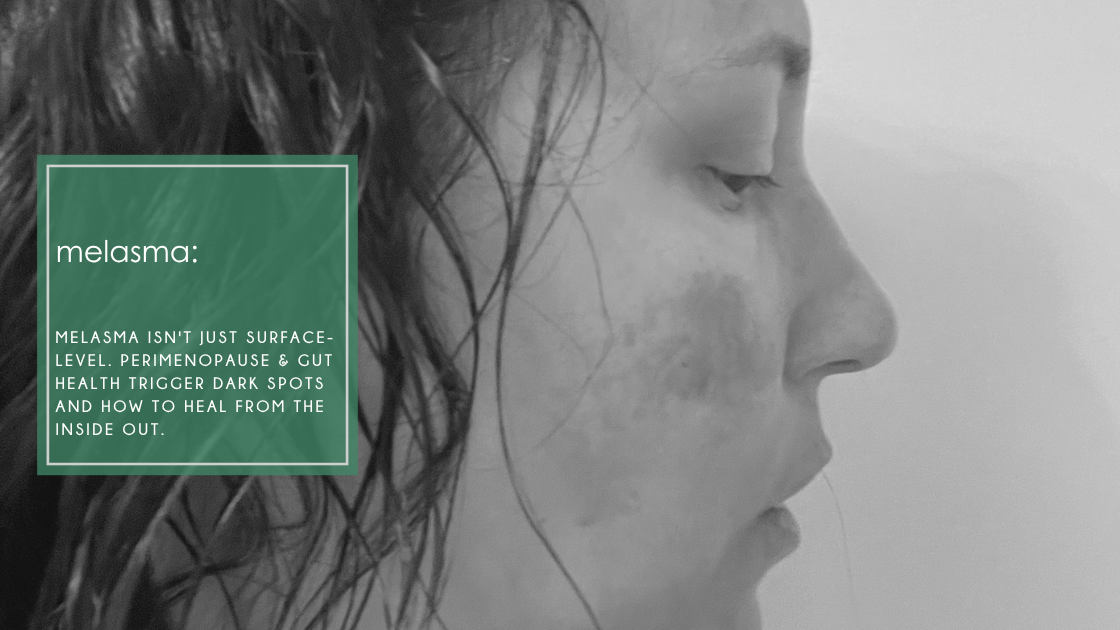
Melasma is a chronic skin condition that causes dark, irregular brown or gray-brown patches on the cheeks, chin, upper lip, or forehead. It is heavily tied to internal shifts and frequently appears during periods of rapid hormonal fluctuations, such as pregnancy, perimenopause, or menopause. To treat it effectively, it helps to know what type you are dealing with.
There are three primary types of melasma: epidermal, dermal, and mixed.
- Epidermal Melasma: Characterized by dark, brown patches with well-defined borders. This type sits in the top layer of the skin and tends to respond well to topical treatments.
- Dermal Melasma: Presents as lighter brown or bluish-gray patches with blurry, soft borders. Because the pigment sits deeper in the skin, it tends to be resistant to standard topical treatments.
- Mixed Melasma: The most common form, featuring a combination of brown and bluish patches. It shows partial response to topical treatments because pigmentation lives in both surface and deeper layers of the skin.
Why Am I Suddenly Getting Melasma in My 40s?
Perimenopause marks a period of erratic hormonal swings. As you enter your 40s, progesterone levels naturally begin to decline, affecting ovulation. Meanwhile, estrogen fluctuates wildly, spiking high one month and crashing the next. When estrogen remains elevated relative to lower progesterone levels, it creates a state known as estrogen dominance.
Why does this matter for your skin?
A group of peptide hormones, called Melanocyte-Stimulating Hormone (MSH), responsible for the production of pigmentation cells in our skin, hair, and eyes. Produced by the pituitary gland and skin, it controls the activity of pigment-producing cells, called melanocytes. While MSH plays a natural role in reducing skin inflammation, excess estrogen activates MSH, driving melanocytes into overdrive. As noted in a clinical study published on PubMed, “While estrogen provides protective benefits against skin ageing, it paradoxically promotes skin pigmentation by enhancing the activity of pigment-producing cells.”
Does Hormone Replacement Therapy (HRT) Cause or Worsen Melasma?
It can, especially if your body’s elimination pathways aren’t able to metabolize hormones. According to research on PubMed, “High-dose oral oestrogen-only HRT has the strongest documented association. Case reports exist for combined oral and transdermal HRT, whereas topical and vaginal HRT formulations have minimal evidence to support their association with melasma.” If your liver and gut aren’t efficiently breaking down HRT, circulating estrogen levels stay elevated and continue to trigger melanocytes.
Is Thyroid Dysfunction Linked to Melasma in Midlife?
Yes. Thyroid dysfunction is a major, yet frequently ignored, internal trigger for midlife melasma. Pigmentation issues are significantly more common in women dealing with thyroid conditions or autoimmune disorders, like Hashimoto’s.
Because perimenopause and thyroid imbalances share overlapping symptoms (fatigue, brain fog, weight changes), parterning with a functional medicine practitioner can help determine whether your melasma is being driven from sex hormones, thyroid dysfunction, or an underlying autoimmune response. Clinical studies confirm that, “There was a significantly higher prevalence of thyroid dysfunction in women with melasma compared with control group . This study suggests that there is a relationship between thyroid autoimmunity and melasma.”
What is the Difference between Melasma and Age Spots?
It is easy to mistake melasma for general sun damage, but their root causes are entirely different:
- Age spots: Small, distinct, oval-shaped spots caused directly by cumulative sun exposure and sun burns over time.
- Melasma: Presents as a larger, broader, symmetrical patch. While sun exposure can darken it, melasma is primarily triggered by internal root causes, such as hormonal fluctuations, thyroid dysfunction, stress, gut dysbiosis, and systemic inflammation.
The Root Cause: How Perimenopause, Gut Health, and Stress Interact
Beyond estrogen and progesterone shifts, two crucial internal systems dictate whether melasma flares or clears: liver detoxification and the gut microbiome. Your liver acts as your body’s primary filtration system. After your body utilizes estrogen, it sends the excess to the liver for Phase 1 and Phase 2 detoxification. Here, estrogen is processed into a water-soluble compound so it can safely be passed into the intestines and eliminated.
However, two major bottlenecks can stall this process: sluggish glucuronidation and an unbalanced estrobolome.
In phase 2 detox, an enzyme pathway called glucuronidation package estrogen so it can mix with bile and move into the gut. Once in the digestive tract, your estrobolome, a specialized collection of gut bacteria responsible for metabolizing estrogen take over. As the Kresser Institute explains, “The estrobolome does not produce estrogen. It determines how much of the estrogen the body has already processed gets eliminated versus how much gets returned to circulation and it can have significant clinical consequences.”
If your gut microbiome is unbalanced, also known as gut dysbiosis, or you produce excess levels of an enzyme called beta-glucuronidase, the bond on the processed estrogen gets broken down before it can leave the body. That estrogen gets reabsorbed right back into your bloodstream, causing estrogen dominance, driving systemic inflammation, and keeping your skin’s melanocytes constantly turned on.
Can Heat and Hot Flashes Make It Worse?
Yes. Melasma isn’t just darkened by direct sunlight, it’s sensitive to internal and environmental heat through a mechanism called Thermic Melanogenesis. Thermic melanogenesis occurs when elevated temperatures stimulate melanocyte cells to produce excess melanin, even without direct UV exposure. This explains why your melasma flares up in the summer months even when you stay in the shade or avoid direct sun. When my melasma was really dark, I was avoiding the sun and constantly layering on sunscreen.
Research published in Advanced Science reveals that, “Heat stress directly activates inflammatory pathways that stimulate melanocytes to produce melanin. Furthermore, when heavy, occlusive formulas trap body heat and sweat against the skin barrier, surface temperatures rise further. If an untinted mineral sunscreen is used, visible blue light can still penetrate the skin and activate the opsin-3 pigment pathway, leading to darker spots despite broad-spectrum UV protection.”
Why Did My Topical Melasma Cream Stopped Working?
Traditional dermatological approaches treat melasma strictly as a surface problem. Standard melasma creams rely on tyrosinase inhibitors, ingredients designed to block the enzymes responsible for melanin production. While these topicals can offer temporary fading at first, they do not resolve the underlying trigger. The moment you experience a hot flash, experience a stressful situation, or a shift in estrogen or progesterone, your melanocytes are reactivated from within, overriding your topical products. Topical creams can help manage the skin surface, but they cannot heal an internal systemic imbalance.
How Do You Heal and Lighten Your Skin From the Inside Out?
True, long-term melasma relief requires a multi-step approach: supporting the skin barrier topically while addressing the root-cause hormone metabolism and gut health internally.
Topical Treatments: Stop “attacking” your skin with harsh chemical peels, aggressive scrubs, or overly drying acids which only create thermal heat and barrier inflammation. Gentle pigment support uses soothing, non-active ingredients, like tranexamic acid, vitamin C, bakuchiol, and niacinamide to calm pigmentation pathways naturally.
Avoid staying in high-heat environments for extended periods (saunas, hot baths, hot tubs, intense workouts). Moderate sun exposure is beneficial for natural vitamin D synthesis, however, to prevent sun burns without trapping heat, wear a wide-brimmed hat, seek shade, and opt for light, physical, non-occlusive sunscreen when outdoors.
Internal Support: Clear and open your detoxification pathways. For women, not having a bowel movement daily is a major red flag. If stool sits in the colon, recycled estrogen estrogen is reabsorbed into circulation. Regular elimination is essential for clearing excess hormones and preventing estrogen dominance. Adopt an anti-inflammatory diet: Remove gut irritants, like ultra-processed foods, gluten, dairy, refined sugars, and seed oils. Base your meals around high-quality animal protein, good, healthy fats (olive oil, grass-fed butter or avocados), and vegetables to help feel beneficial gut microbes.
Support gut repair with glutathione: Glutathione and N-acetylcysteine (NAC) are powerful antioxidants that support gut lining integrity, reduce oxidative stress, and naturally inhibit tyrosinase activity. Clinical trials show that targeted glutathione support helps lower melasma flare ups.
Does Melasma Ever Go Away After Hormone Levels Balance?
Yes, you can successfully clear and lighten melasma, just as many women experience when their hormones settle post-pregnancy. However, because melanocytes hold a cellular memory, your skin will always remain sensitive to future triggers. A sudden shift in stress, illness, hormonal fluctuation, or heat can temporarily reactivate pigment pathways. By keeping your liver detoxification pathways open, nourishing your microbiome, and maintaining balanced hormones, you give your skin the internal stability it needs to keep melasma in remission permanently.
Ready to Heal Your Melasma from the Inside Out? How Functional Medicine Can Help
Real, lasting skin transformation happens when you stop guessing and start testing. Instead of cycling through expensive topical creams or treatments that only address the surface, functional medicine looks at the whole picture. Through comprehensive lab testing, evaluating your sex hormones, full thyroid markers, estrobolome health, and inflammatory pathways, we uncover the exact internal drivers behind your pigmentation.
If you are ready to stop fighting your skin and start healing your body from within, we are here to guide you every step of the way.
Click here to learn more about our functional medicine programs and schedule a free call today.